

Mu collecting points – Mu Xue
The Mu points , known as collecting points, are acupuncture points located on the chest and abdomen, and they are of great importance in Chinese medicine. Let’s look together at what they are used for.
Contents
Location of the Mu points
There are 12 of these points, located on the chest or abdomen.

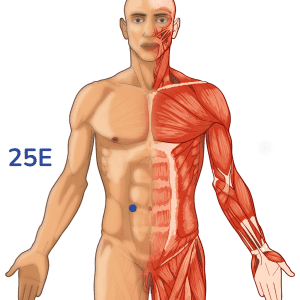


Indications of the Mu points
Each of these points is a place where the Qi of an organ or bowel gathers; here is the correspondence:
They are the projected shadow of the organ and bowel, facing the actual organ system. They therefore have a strong, rapid and direct action on the function of the organ or bowel. That is why I use them during acupuncture or Tuina massage sessions. I sometimes notice pathological signs around a given Mu point, which tells me that the corresponding organ is affected.
Here are a few concrete examples to illustrate this:
- A person comes to see me with a digestive system disorder. They suffer from digestive pain and specifically complains of pain in the epigastrium, with nausea and vomiting. In this case, I will work on the point ZhongWan , which is the Mu point of the Stomach. This stimulates its function, which is to harmonize the Stomach; this can calm the pain and reduce the nausea and vomiting;
- Another person complains of constipation. For a few days, they have been going to the toilet much less often. In this case, I will stimulate the Mu point of the Large Intestine , namely TianShu. This harmonizes the Large Intestine, which can then eliminate stools more easily. Depending on the cause of the constipation, additional points will be chosen;
- For a person who has had asthma for 3 days and says that it gets worse with emotions, I can, for example, use the Mu point ZhongFu to tonify the Lung , as well as the Mu point of the Liver , QiMen , to treat the emotional component;
- A final example is that of a person who complains of urinary retention. To stimulate the flow of urine, I will work on the Mu point of the Bladder, ZhongJi. In this way, I support the work of the Bladder and allow urine to flow. This point can also be used in cases of incontinence, cystitis, gynecological problems or male sexual problems.
Of course, I will also work on other points so that the treatment leads to a good result.
Palpation of the Mu points
Palpating these points makes it possible to assess the state of an organ. As they are on the abdomen, close to the organs, they are easy to palpate. This way I make sure I am working on the right points. When there is a disorder, the point becomes reactive (a so-called ‘Ashi’ point), meaning that it is painful on palpation. It may also feel cold or hollow.
If I detect a disorder of a given organ, I act on its Mu point, dispersing it in case of excess or tonifying it in case of deficiency. When cold is present, I can apply moxa to bring warmth and expel the cold.
To learn more about the meridians and the different families of acupuncture points, I invite you to get my illustrated book Meridians and acupuncture points in Chinese medicine.
Take care of yourself 🙏🏼
Share this article with your family and friends 🙂


