
Large Intestine meridian pathway
The Large Intestine meridian, hand Yangming, begins at the outer nail corner of the index finger, at the point Shangyang.
It rises along the outer edge of the index finger and passes through the first web space of the hand, crossing the adductor pollicis, at the point Hegu.
It then passes through the anatomical snuffbox at the point Yangxi.
Then it rises on the front part of the outer side of the forearm to the point Shousanli.
It passes through the middle of the outer side of the elbow at the point Quchi.
It rises and passes through the deltoid V at the point Binao.
It rises to the shoulder and passes below the tip of the acromion at the point Jianyu.
It goes backward to reach the point Dazhui (C7-T1, belonging to the Dumai) then turns forward again and enters internally through the point Quepen (costoclavicular space).
It passes through the Lung and reaches the Large Intestine.
At the level of the neck, a branch leaves the main pathway and rises along the neck, crosses the mandible, then rises along the cheek, passes between the upper lip and the nose and ends on the opposite side, below the wing of the nose, at the point Yingxiang.
At this point the connection, the relay, is made with the next meridian, the Stomach meridian , foot Yangming.

Large Intestine meridian acupuncture points
The Large Intestine meridian has 20 acupuncture points; here are the main ones


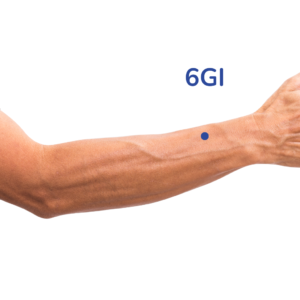
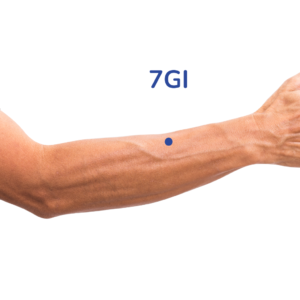


Large Intestine meridian description
The Large Intestine includes the colon and the rectum.
It is the official in charge of transport.
It absorbs the surplus fluids and, with its waste, turns everything into stools, which it carries to its end.
If it is deficient, transit is abnormal and there may be diarrhea or constipation.
It has 2 physiological functions:
- Transporting waste and managing fluids;
- Governing the fluids.
It receives the surplus fluids and waste from the Small Intestine and absorbs them to form the stools and evacuate them. The Large Intestine (LI) therefore takes part in the processing of fluids. For this descending function to be possible, the descending action of the Lung is needed, as well as the Qi Hua of the Kidney.
If Kidney Yin is deficient, there may be constipation.
If Kidney Yang is deficient, there may be diarrhea or constipation due to too much Cold.
If Kidney Qi is not solid, there may be chronic diarrhea, as it no longer acts on the LI.