
Path of the kidney Meridian
The kidney Meridian, Foot Shaoyin, begins at the little toe at the point Zhiyin.
Then it runs along the arch of the foot and passes through the hollow of the arch at the point Yongquan.
It continues its course to reach the inner edge of the foot, below the tubercle of The scaphoid (navicular bone), and then passes behind the medial malleolus.
It runs downward in a loop to end just below the medial malleolus, then runs back up along the leg—the inner side, the back, then the knee, and finally the thigh.
It enters internally through the point Changqiang, it runs along the front of the spine to connect with the Bladder and connect to the Kidney. It takes this opportunity to do a little shopping; it passes through the Liver (hence the direct connection between the Liver and the Kidney), then through the diaphragm and into the chest cavity.
Here, they say it enters the Lung (connection to the Lung), and then passes through the throat.
And it will end on either side of the root of the tongue (the connection between salivation and the kidneys).
From the lung, internally, there is a branch that branches off from the main pathway and connects to the pericardium and the heart.
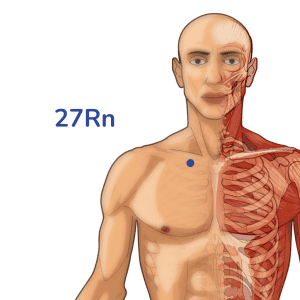
From Changqiang, there is a branch that does not enter internally; instead, it runs upward along the front of the abdomen and thorax. this External branch will cross the abdomen 0.5 Cun from the midline and run along the thorax 2 cun From the midline. this line Will extend upward until it ends below the clavicle, between the 1stst the rib and the collarbone at the point Shufu (the infraclavicular fossa).
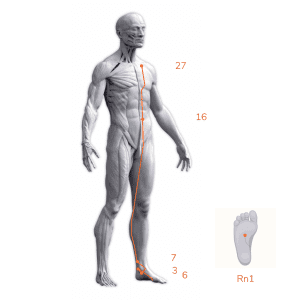
Acupuncture points on the kidney Meridian
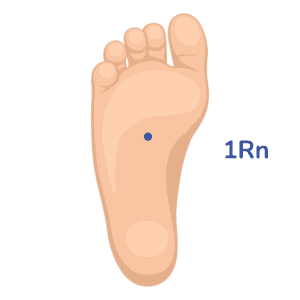
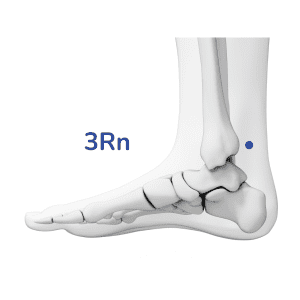
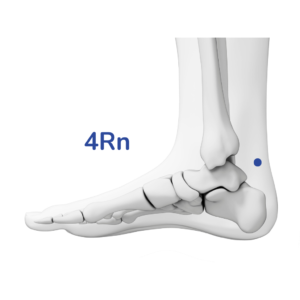
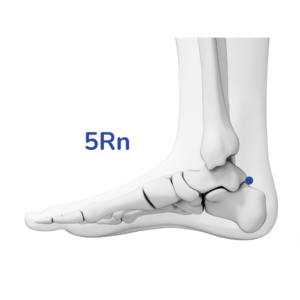
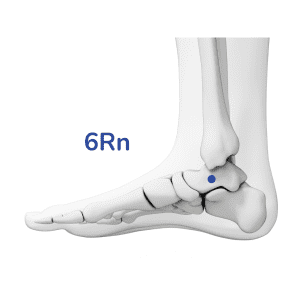
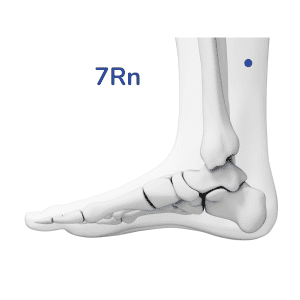


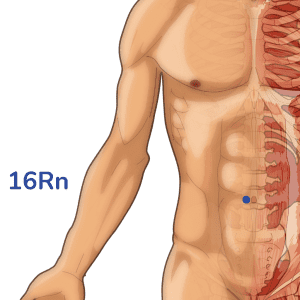
Description of the kidney Meridian
The kidney corresponds to thewater. It is the yin within the yin.
Her the season is winter, his emotion, fear, its direction is north, its color is black, and its flavor is salty.
In the Neijing, it is the civil servant in public works, in charge of construction.
Its main functions are to store gasoline, regulate water and other liquids, and regulate the intake of Qi.
It is the root of the yin and yang of the organs and viscera, the root of the anterior heaven.
Its physiological characteristics: It is the root of the organs and viscera. It stores true yin and true yang, which are the roots of yin and yang.
True or original yin, Mingmen the kidney is the source of the body’s yin energy; it moisturizes and nourishes all parts of the body.
Kidney yang is the root of the body’s yang energy; it drives movement and warms the entire body. It is also called the “true fire” or the “Mingmen fire.”
The yin and yang of the kidney give rise to one another, regulate one another, and support one another, thereby maintaining the body's vital functions.
Gasoline should always be conserved—it's too precious.
The fire must remain hidden and smoldering. It must be present at all times without, however, being excessive. If certain organs are deficient in yang, this fire can come to their aid and support them.
➔ That is why, in clinical practice, the kidney is never fragmented.